Get Lost in Greece's Monemvasia, Part One

Very uncharacteristically, I found myself in a light debate with one of my best friends last year.
monemvasia tourism
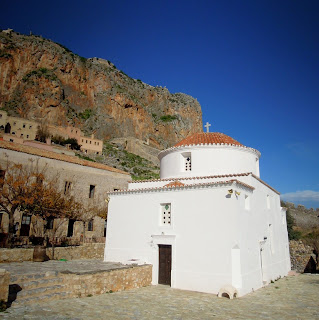
A view of the Monemvasia lower town with two of its most in-tact churches
OK, characteristically.

A bit of back-story: This friendwe'll call him "Todd"was dating (and is now engaged to), a flight attendant. Not only is said flight attendant beautiful, devoted, and hilarious, but she also has the unique power to bestow upon Todd one of life's greatest gifts: no, I'm not talking about the miracle of childbirth (although this, I suppose, is also in her power)I'm talking about the miracle of completely, unabashedly FREE airline travel.

Todd had had these travel benefits for a good year or two and Iever-vigilanthad noticed that not only had he not come to visit me out in Jackson, Wyoming in the four years since I had lived there, but he had also neglected to make any trips out of the country or to any locale that wasn't some bustling American city.

I told Todd that he better come casually suggested that Todd visit me during my European travels, whereupon he replied with something along the lines of "I don't see the point in traveling, most places are essentially the same wherever you go."
church cross
The remains of a church and its cross against the sky
monemvasia churches
The pristine Panagia Chrysafitissa Church
We won't get into the many ways in which I thought his outlook was painfully and dreadfully incorrect. Suffice it to say that I did my best to show him of the error of his ways, and I doubt that I was successful.

What I've now learned is that if a person is convinced that every place in the world is essentially offering the same experience, don't waste your time with logic or debate tactics attempting to make them see the light; just knock them out, tie them up, and put them on a plane to Monemvasia.
Approaching the fortress
They'll thank you upon landing.

As you approach this ancient city, the feeling begins to take over. It's a strange one: some mixture of disbelief, wonderment, and romance. And don't try, there is no escaping it.
Overlooking the lower town
The feeling remains, growing stronger as you cross over the single causeway linking Monemvasia to the Peloponnesian mainland. In fact, Monemvasia translates to "single entrance," and as you approach the stony, timeworn  gates to the city, it sinks in that the single entrance is the only exit as well...unless you're a really, really good swimmer. This place was made to protect itself.

Just barely a mile long and a mere 900 feet high, you have to wonder how the Greek gods jammed so much pure magic into such a small area.

An earthquake in 375 A.D. set this great rock apart from the rest of Greece, and there it lay uninhabited until 583, when the local Byzantines set up shop in order to avoid outside invaders to the mainland. There they stayed in relative peace for about 700 years, after which battles for occupation ensued nearly until the 1800s.
The wall surrounding the entrance to the lower town

Clearly Monemvasia has always been the place to be; since it's initial occupation, "ownership" of Monemvasia has changed hands at least seven times.

I'd been introduced  to this other-worldly retreat by the gracious owners of the house and pets we'd been "sitting" for the past three weeks. I went back when my parents came to visit over Christmas. And I went for a third time because honestly, I couldn't get enough.

John and I treated ourselves to two nights in this enchanted town for two reasons:
#1. We had spent nearly eight months traveling and paid for accommodation for a mere total of two nights.
#2. It's off-season, baby!
The view to the right from our hotel room's patio

If a splurge was in order, this was the place for it. But although we attempted to "splurge," I'd say the final payment was absurdly inexpensive. An apartment-like room with a balcony, fireplace, and free firewood and breakfast set us back a mere 60 euros per night at the Hotel Byzantino. What's notably special about the room was that it has that Monemvasia character; it's easy to feel as though you're actually "living" somewhere and experiencing the lifestyle, not just staying in an aseptic hotel room. Even with the shower being half the size of your refrigerator and a paltry breakfast of toasted white bread and jam (but with fresh OJ and coffee!), we couldn't have asked for more at that price.

If I positioned myself just-so and looked out of our window, I could imagine that I was on an ancient schooner, sailing toward the Parthenon to pay tribute to Athena. We were that close to the crystal blue water and we had it all to ourselves. Thank you, off-season rates.
aaaaand view to the left
Yet we couldn't stay sitting on our balcony all day playing backgammon. There was history to see.

The lower city of Monemvasia is filled with old houses, shops, and about four of the original 40 churches, most of which are in a state of disrepair. It is almost enough to lose yourself within these cobblestoned streets, stealing glimpses of the sea, stepping into a shop selling local honey-wine, or trying to catch a glimpse of one of the dozen-or-so year-round residents.
Strolling...
That is an upside-down Christmas tree. A little late, a lot cool
Our favorite cafe/bar, Enetiko, was loaded with handmade art, like this beachwood dragon guarding the bar (look closely)
A wine cellar/spice shop
More windy streets
The one possible problem with visiting a tourist town in the off-season is that many of the stores and restaurants aren't open. Luckily Marianthi, the restaurant we chose (which only had one competitor), was a winner.

We started dinner off with some local raki served straight, which I would compare to a mild moonshine. It was followedby cabbage rolls stuffed with a mixture of ground beef, pork, and spices and served with Greek yogurt sprinkled with paprika; then fried Greek cheese; and finally we shared an entree of locally-caught fried red mullet.
There were two older ladies working, one as the chef, and one as the waitress/cat chaser. The chef casually sits down at your table to take orders and tell you what's on the menu for the night before heading next door to begin cooking. Old women chefs, as a rule, are generally the best. Meanwhile, if you're lucky, an accidentally-opened door might let one of the bountiful cats from outside leak in, which causes the waitress to dance around while beating a thin bamboo stick against the walls and floor. The sound, I suppose, is meant to scare the cats...

But we all know that cats don't actually get scared.

It's a informal restaurant, to say the least, and the food is divine.

Afterwards, we stopped by an uber hip lounge across from the restaurant where we sat on chic cushions next to chic tables and imbibed chic beverages. That is, if you can call John's White Russian chic. My B&B (warmed brandy and bénédictine), however, makes the chic list without any hesitation.
candles in paper bags...too hot to be cool
Of course we brought the cards...
How a place like this exists amongst so much antiquity, I don't quite understand. But it's nice in an opposites-attract kind of way.

The next morning, despite a mild desire to lounge around as intensely as possible until nightfall, we set off to the very top of our huge rock to discover the real bygone days of Monemvasia.
Heading up the rock on a slightly ominous Monemvasia morning
But that is a whole different story.

Stay tuned (receive updates in your inbox by clicking here)!

For more pictures, find the Chowgypsy on Facebook

Hunting the Wild Asparagus in Greece

Volunteering on farms is nice.

But petsitting in a modern three-story home in coastal Greece?

I could get used to this.

Here in Elea, we are isolated among the olive trees and it feels as though John and I are a two-person audience for the daily sunsets that unfold over the ocean.

This is mine?

In short, I'm not sure how I'll manage to leave this place.

On a recent stroll with the dogs, we ran into some expat neighbors who invited us over for a drink. The wife, Kathryn, was cooking up a sort of vegetable strudel and casually mentioned the presence therein of some wild asparagus she had discovered earlier.

Here's the thing:

You can't just casually mention you found wild asparagus to someone like the Chowgypsy.

The olive trees and an old stone house in our backyard as I set out for the hunt

Controlling any exterior show of unbridled excitement, I then began privately obsessing over the question of how I would find some wild asparagus of my own.

Since the asparagus I find in the grocery store is usually from South America or some other far-away locale, it's one of the foods that I don't buy as an attempt to lower my culinary carbon footprint (it goes along with one of my reasons for why you should consider having a garden).

But I miss asparagus—it's up there with bananas and avocados as one of the foods I long for most as I follow this ideology of eating local and seasonal foods.

So when it came to the question of finding guilt-free wild asparagus, it simply had to be done.

Just some casual ruins on my asparagus-hunting route (everythingisamazinghere).

I set out the next day.

Sure, I had no idea where to look, I didn't actually even know what to look for, and I really didn't know if even the conditions were right.

Why hadn't I asked Kathryn these things?

To the surrounding "backyard" I went. After over an hour of walking in slow motion, squatting, staring, and moving on, I headed back to the house discouraged, but resolved to try again after the next rain.

My downcast eyes fell upon a splay of wild olive trees and I paused, noticing the underbrush. What if...?

Same routine: approach slowly while scanning the area, squat, stare...

And there it was. My first wild asparagus spear.

Lithe and appetizing, I knew it had been waiting for me.

Greece, you have made my life.

I feel like I am living a fairy tale. A fairy tale where the fairies eat human food like wild asparagus, of course.

They weren't exactly plentiful, but with enough stalking underneath the cover of the ancient olive trees (which, I'll mention, happened to be strewn all over the local surroundings) I found plenty of those precious and lonely soldiers.

Turns out I had walked by them several times during our stay, not noticing how all along the prickly weeds I'd avoided had actually been harboring these verdant pillars of gastronomic rapture.

Spread out in a seemingly random pattern among the underbrush, some were a deep purple, some rich and vibrantly green. Some were strangely tree-like, with tiny asparagus "branches" laddering up the stalk (which represented older stalks), and some resembled the column-like form seen in grocery stores.

Like most wild-born foods, they were skinnier than what you typically buy from commercial farms.

I pulled out my knife and carefully navigated the prickly plant from which it grew, cutting a chosen few for Sunday brunch.

One of the most beautiful things I've ever seen.

I was foraging. I was foraging in the wild!

This is what I've been working for.

This is what good eating is all about: finding what's fresh, sustainable, and delicious and proceeding to eat it with abandon.

Sticking out like a sore and very tasty thumb

Here's a purply stalk that's past its eating prime since it has
 started to "blossom"

The flavor of wild asparagus is ever-so-slightly smoky, somehow reminiscent of buttery popcorn, and lacks the mild bitterness that most South American asparagus harbor.

You feel like you're eating nature, but in a good way. And don't be be surprised if while you're chewing random images of enchanted forests with towering redwoods and waving toadstools pop into mind.

It's simply one of those magical foods.

You think you're sooooo clever amidst all your thorns and camouflage greenery.


Not wanting to overpower the magic of a deliciously unadulterated mouthful, I kept brunch simple.


It is a recipe that needs very little explanation:

Wild Asparagus with Creamy Polenta and Soft-Boiled Eggs

1. Make the polenta according to package directions (using some butter, salt, and pepper, and a bit of milk toward the end for creaminess).

2. In a non-stick pan, sautee some red onions for 10-15 minutes. Set aside. There should be a little EVOO (or butter, you crazy thing!) still in the pan. If not, add some more for the amount of asparagus you have.

3. Meanwhile, for soft-boiled eggs, gently place whole eggs in constant-but-barely simmering water for 5-6 minutes, soak in ice bath afterwards. Keeping egg upright, gently crack the top and use a small spoon to go between the shell and the egg white and peel the top of the shell off.

4. Over medium high heat in the same pan that you used for the onion, add the wild asparagus and cover the pan for the first 1-2 minutes. Remove cover and saute for 3-5 minutes, or until light browning begins to occur on some of the stalks. If any of the asparagus are purple, they should turn green (food science excitement!!). Do not overcook.

5. Plate in the way that makes you happiest. Wild asparagus day is your day, kiddo.

Who needs a soft-boiled egg cup when you can simply make a polenta nest!? #ilovefoodnests

Eat. Indulge. And never, ever forget this meal.


Stay tuned, because soon we will sadly leave our generous hosts and beloved dogs, setting off to Monemvasia and a farm further north on the Peloponnese.

And if you'd like to learn more about eating local and seasonal foods, check out the Slow Food Movement!

Petsitting and Playing House in Lakonia, Greece

It leaves you speechless.
greece beaches
Papadiaika: our secret beach where the dogs can run wild
Whatever I expected out of Greece, it wasn't this.

I've been lead to believe that it was only in Tuscany or Provence that you could be so fully surrounded by ancient and gnarled olive groves...or that it would have to be somewhere like Granada that I could sit by the sunny sea while resisting the call to don my skis from distant snow-capped mountains...and I assumed that it would have to be Southern California where I could see the ocean lap upon long sandy beaches and then collide with abrupt cliffs a mere mile down the shore.
A view of the orange and olive groves stretching out to the sea on a walk in the backyard
And yet, here it all is. Here, in a single, breathtaking locale. Here, standing quietly by as people rave about Italy or France or whatever hot destination is in this month's Condé Nast Traveler.

How could I have known that all of those breathtaking vistas had rolled up into one tidy yet wild bundle and waited to present themselves to me right here in Greece?

Calling myself lucky would be an understatement.
Our honorary pets, Foxy and Ellie
John and Ellie on what we call the "private" beach
That we were chosen out of several other applicants to house and pet sit in this Heaven on Earth, I'll be forever grateful and mildly bewildered. I must say that when we set out to travel the world on a budget, I didn't know it would end up being this leisurely.

We're currently situated in Elea, a tiny town within the region of Lakonia that falls on Greece's Southern Peloponnese Peninsula. Reaching it takes a good four-hour drive south from Athens that passes through Sparta and just misses Kalamata. It's not too difficult along the way to imagine yourself riding with Zeus in his chariot, rolling through an ancient land of staggering mountain ranges and seemingly-untouched landscapes.
An old rampart that overlooks the town and the sea
The  steep cliff that the rampart stands on
And all the better that the drive is long, it's probably what discourages many people from visiting. Fewer people means more untouched beauty all to myself.
snow in greece
Our abandoned beach and the distant Taygetos Mountains
Running straight into hypothermia
We've spent our days walking through the olive and orange orchards, hunting for wild asparagus (more on that later), cooking, playing boardgames, and simply basking in this beauty-soaked  lifestyle.
The town of Elea: where olives and oranges unite
Perhaps it's not for everyone--no large supermarkets, no nightlife, no theaters.  Hardly any English speakers and....wait for it...no TV (at least where we're staying).

But if you enjoy the idea of stumbling upon ancient ruins during your daily strolls, if you like to play backgammon while the sun sets over the olive groves, or maybe if  picnics on abandoned beaches is more your style...skip the islands and consider a visit to Southern Peloponnese.
An old blue-roofed daredevil of a church
The olive trees through a nearby ruin
There's just one thing: if you do decide to come, please, just keep it a secret.


Follow the Chowgypsy in your inbox (click here!), and stay tuned for our visit to the ancient city of Monemvasia...

If you're interested in opportunities to house/pet sit abroad, check out TrustedHouseSitters.com or MindMyHouse.com.

ShareThis

LinkWithin

Related Posts Plugin for WordPress, Blogger...