If I were to go back to the states
tomorrow to begin my own garden,
there are at least two things that I’ll be able to do with great precision and
excellence:
1) Freak out a little when I find a spider crawling on me.
2) Weed.
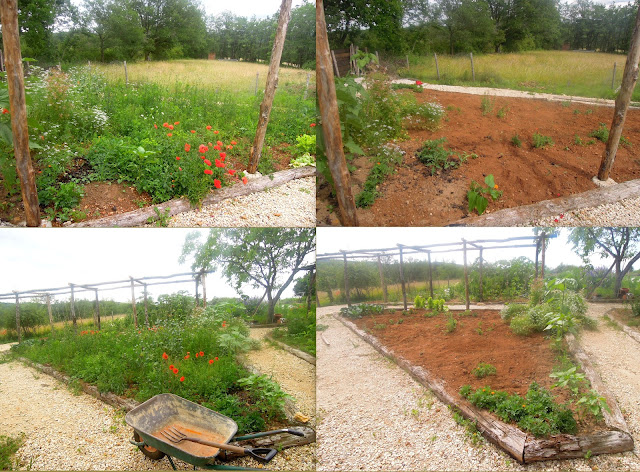 |
| I told you we've been weeding... |
Wwoofing in the kitchen gardens of
smaller homes (as we've done so far) often, I've learned, involves a lot of weeding. In fact, it just
might be the reason that wwoofing exists at all. Why not
bring some homeless vagabond Americans ‘round to do the down-and-dirty grunt work?
Nonetheless, I’ve managed to find a
certain enjoyment in the sharp, crunchy sound of yanking a weed out from its
uninvited resting place. It becomes meditative (almost), this process.
Scan,
uproot, pull, shake, toss into pile, repeat.
 |
| John gathering weeds...view of/from the garden |
There are, I must mention, a few
other helpful tidbits I’ve garnered form Julius & Joelle’s expansive
store of garden knowledge.
For example...
1. Marigolds repel aphids, keeping them away from
the edibles. You can also eat the marigold petals (along with the flowers
mentioned in this blog post)
I better use this chance to convey how much
Joelle [very reasonably] despises the genius who decided to encourage people to
spray pesticides all over the garden rather than to plant a natural variety of
plants as a form of pest-control. Under the latter method, while other people simply think you’ve created an intricate and beautiful plot
of land, you can puff that chest up knowing that you’ve actually established a
functional, eye-pleasing garden with its own innate system of checks and
balances.
It’s yet another tragic case of abandoning natural gardening wisdom for a “quick fix” solution. Never mind that spraying pesticides
over these porous products that you will soon be eating just might have some health consequences. An excellent resource for natural gardening can be found here.
2. The desert succulent purslane, while considered a
pest in a garden (discard a single leaf and a whole batch could pop up),
is edible! I'd never considered eating a succulent, so this is great, especially since it’s supposed to be rich in omega-3s (take THAT, cholesterol!). It’s pretty tasty—stout and, um, plant-like in flavor…Throw it in
a salad or puree in a soup. Check out this link for more edible “weeds.”
3. Roots don’t like lots of oxygen, so don’t expose
them for long, and when you plant something, pack the soil down well if the instructions say to do so. Don't be afraid.
 |
| Protector of the tomatoes...can ya see it? |
|
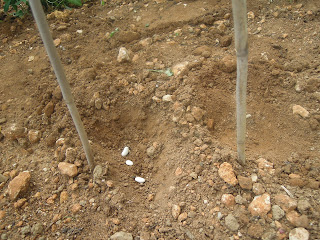 |
| Seeds for green beans, easy as that! (notice the "well"?) |
|
4. Look, you
don’t have to buy a fancy water-sprayer-thing, just stick a pitchfork in
the ground and snake a hose through it using the pitchfork's handle to continuously press the sprayer's handle down
 |
Wrap your hose up in a pitchfork, using the handle
as a lever to press the sprayer, and you have
an easy way to water your plants |
|
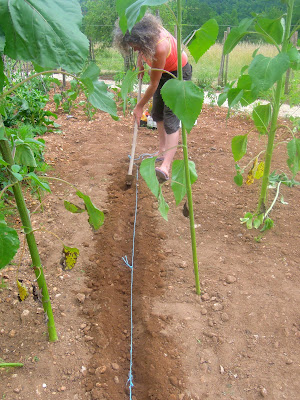 |
Joelle makes a trench for the haricots verts (green
beans) and keeps it straight by tying a string between to
pole and hoe-ing underneath for the "watering trench" |
|
5. I’m done buying charcoal. Thruwidit. Make your own charcoal with—you
guessed it—wood!
|
|
| Joelle gets primal on the grill |
6. You can now make your own "self-watering" tomato plants (kind of…)! Leaves on tomato plants don’t like to get wet, so Joelle showed
me this method, and concurrently lowered the blood pressure spike that I experienced upon seeing all of the plastic water bottles they'd been hoarding.
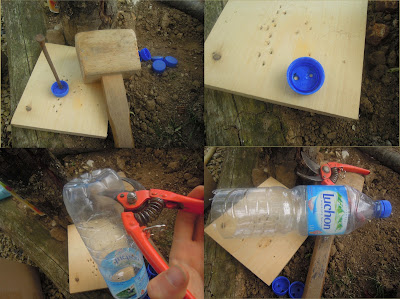 |
| making our self-watering tomato bottles |
Directions: -Save your big plastic bottles (I don’t typically support
the use of plastic bottles—thank you, Massachusets!—but I think this might be an acceptable excuse. Just
recycle afterwards, ok?)
-Take the lids off of the bottles, you’ll use these later
(hey, cliffhanger!)
-Cut or saw off the very top section of the bottle. Play some loud music, because cutting plastic might make your ears bleed
-Now take those lids, a piece of wood, and a large nail, and hammer 2 holes in the lid
-Put said lid back on the bottles
-Plant your new bottles about 5-6 inches away from the plant you’d like to water, and just deep enough so that they don’t wobble. Pack the soil down. If you’re planting on a hill, keep the plant downstream of the bottle.
-Fill your plastic "flower" up with water and enjoy your tomatoes’ happiness. The water gets sucked down pretty quickly, so it's not a hands-off watering method, but this way you don't have to root around to find the base of your tomato plant.
 |
| and voilà! |
Some pictures follow of the best eggplant I’ve ever had. Made, of course, over a simple wood fire. Salt, pepper, EVOO, and a little char.
Bam!
 |
| Oh, did you say local lamb chops? No? OK, well...do you want some anyway? |
And there you have it--a taste of what we've been learning in the weeks at Julius & Joelle's farm.
 |
| How 'bout a little sunset with that dinner? |
Follow
in your inbox to stay tuned!


